Insulating Metal Buildings & Pole Barns on the Texas Gulf Coast
Published: July 2026 | 6 Min Read
Metal buildings are everywhere on the Texas Gulf Coast — backyard shops, pole barns, equipment sheds, warehouses, and the fast-growing wave of barndominiums. They go up quickly and cost less than stick-built structures. But leave one uninsulated in Southeast Texas and you'll discover its biggest weakness within the first humid week: it sweats, it drips, and it becomes an oven. Here's how to insulate a metal building the right way for our climate.
The Condensation Problem Nobody Warns You About
Steel is a fantastic conductor and a terrible insulator. When the humid Gulf Coast air inside your building — or the cool night air outside — meets a metal panel at a different temperature, water condenses right on the surface. People often think their roof is leaking when it's actually the building "sweating." That constant moisture:
- Rusts screws, fasteners, and the panels themselves
- Drips onto tools, vehicles, hay, and stored equipment
- Rots any wood framing or purlins
- Breeds mold and mildew in the humid interior
Solving condensation isn't a nice-to-have on the Gulf Coast — it's the entire point of insulating a metal building correctly.
Why Fiberglass Fails in Metal Buildings
The vinyl-backed fiberglass rolls a builder drapes over the purlins during construction are cheap, and they act like it. Over a few Gulf Coast summers they sag away from the roof, sponge up and hold moisture, compress until their R-value collapses, and leave gaps at every seam where humid air pours through. For a building you actually want to use year-round, fiberglass is a short-term answer to a permanent problem.
Why Closed-Cell Spray Foam Wins
Closed-cell spray foam is the gold standard for metal buildings in our region, and it's not close. Sprayed directly onto the inside of the steel, it solves every failure mode of fiberglass at once:
1. It Stops Condensation Cold
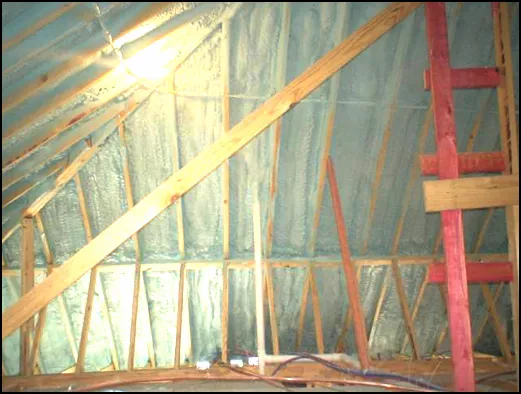
Closed-cell foam is a Class II vapor retarder that bonds seamlessly to the metal. There's no longer a cold surface or a vapor path for moisture to condense on, so the sweating and dripping simply stop.
2. It Delivers the Highest R-Value Per Inch
At roughly R-7 per inch, closed-cell foam packs more thermal resistance into less thickness than any common insulation — turning an unusable metal box into a space you can actually heat and cool.
3. It Adds Structural Strength
Rigid closed-cell foam effectively glues the panels and framing together, adding racking strength. On a coast that sees hurricanes and tropical storms, that extra rigidity is a real resilience upgrade.
4. It Never Sags or Falls
Because it's adhered to the steel, foam can't droop, settle, or pull away from the roofline the way batts do. Spray it once and it performs for the life of the building.
Barndominiums: A Special Case
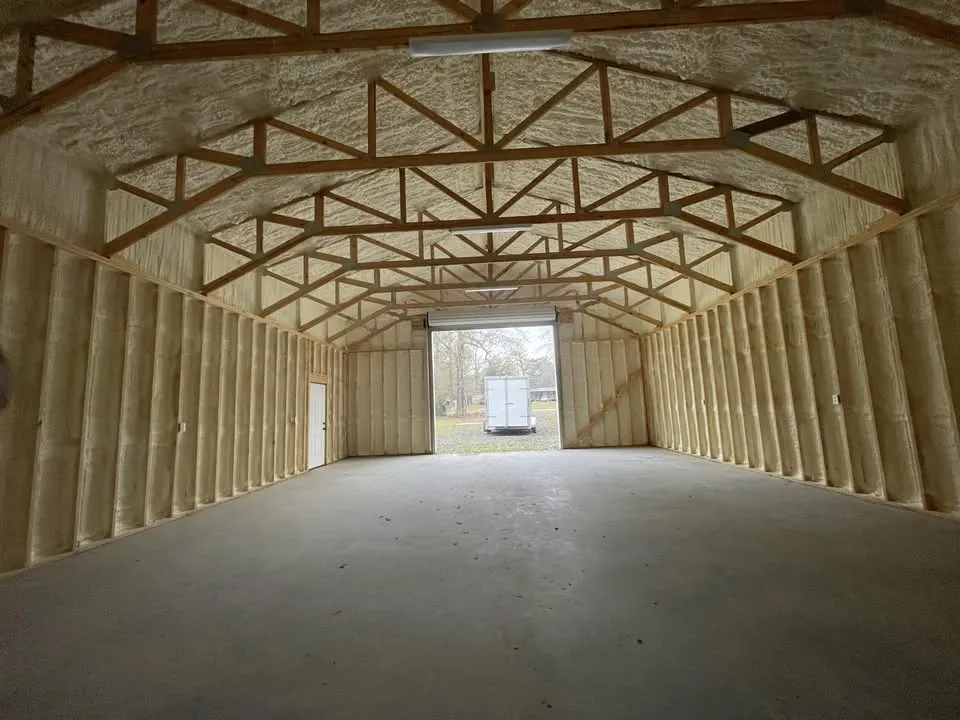
Barndominiums are booming across Southeast Texas, and they raise the stakes because you're living inside the metal shell. Spray foam is not just the best option here — it's often the only practical one. It creates a sealed, dry, comfortable, energy-efficient living envelope that keeps humidity out and conditioned air in, which no draped fiberglass can match. If you're building or finishing a barndominium, plan the foam in from the start.
Shops, Pole Barns & Warehouses
Whether it's a hobby shop near Beaumont, a pole barn full of equipment out in the county, or a full commercial warehouse, the same principles apply. Match the foam thickness to how the space will be used — a climate-controlled shop needs more R-value than a barn where you just want to stop condensation and knock down the heat. That's a conversation worth having with an experienced installer.
Ready to fix a sweating shop or plan a new build? Explore our metal building, pole barn & shop insulation services, learn more about closed-cell spray foam, or see how we serve Beaumont & Vidor.
Stop the Sweat in Your Metal Building
Our mobile rigs handle shops, pole barns, and warehouses of any size across Texas and Louisiana.
Get Your Free Quote